
In 1908, psychologists Robert Yerkes and John Dodson established a principle still foundational to performance science: a certain amount of stress sharpens focus and reaction. But there is a tipping point. Beyond it, stress doesn't sharpen — it shatters.
Heart rate spikes too high, tunnel vision sets in, problem-solving collapses. The crash comes sooner when the task is unfamiliar or confidence is low. Familiarity and confidence delay the crash — stretching the peak. Building that resilience is the difference between someone who maintains function under extreme stress and someone who collapses when it matters most.
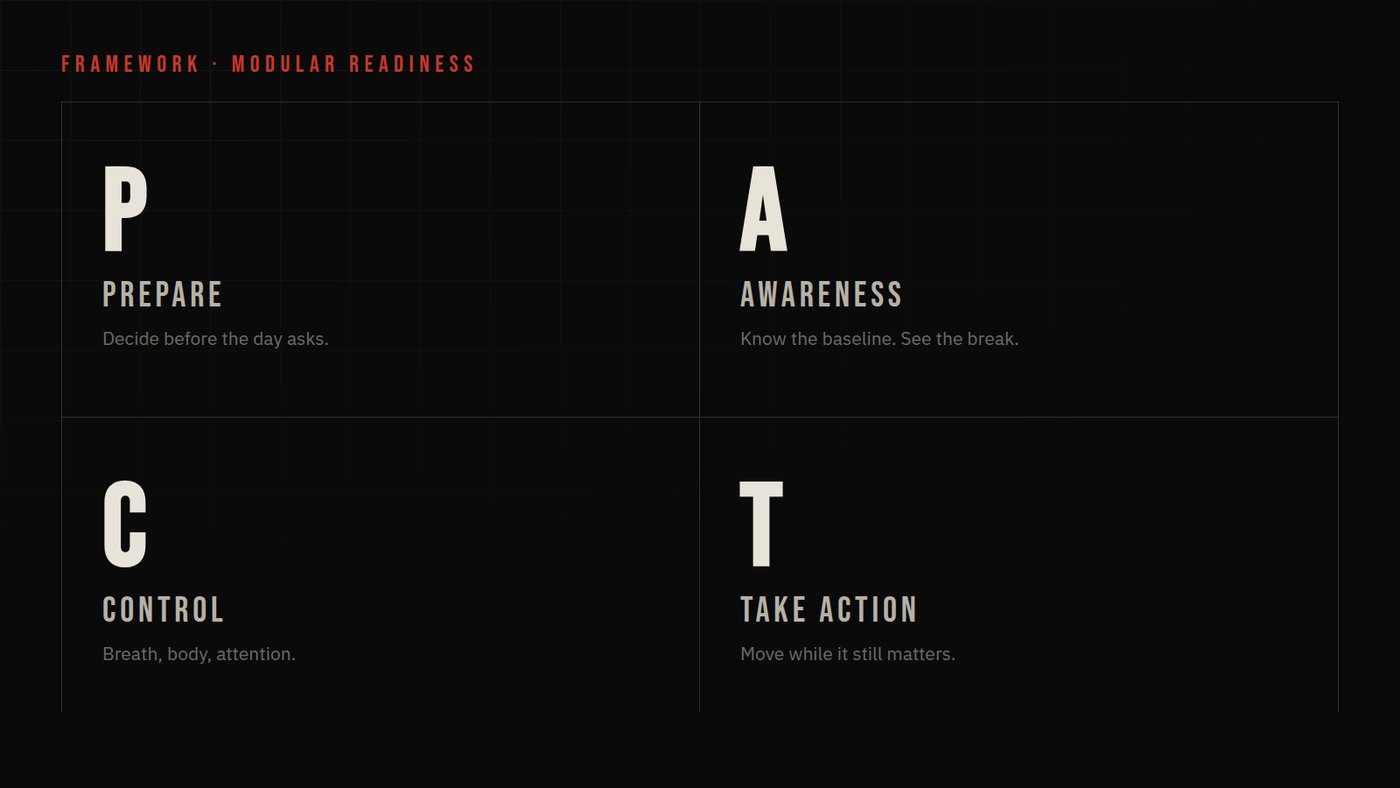
This is the performance science behind PACT. PACT is not a sequence. It is a system — each component reinforcing the others under stress.
THE FOUNDATION: DIE WELL
"Die Well" is not a slogan. It is both a mortal and a moral decision made in advance.
Every person who has stood at a threshold — uncertain, unsure what waited on the other side — was doing exactly what their brain is wired to do: survive. Die Well is a countermeasure. It is the conscious acceptance, before the call ever comes out, that survival is not always the priority. That some outcomes are worse than death.
One core element is practicing premeditatio malorum — the Stoic discipline of visualizing the worst outcome in advance. Not to accept it, but to strip it of its power to paralyze you. Modern performance psychology reflects the same principle: cognitive rehearsal and stress exposure reduce novelty, and novelty drives panic.
The Die Well mentality prepays the emotional debt of life-threatening decisions.
THE FOUR COMPONENTS
-
PREPARESee it before it happens.
Mental preparation is the first and most important step. Cognitive rehearsal converts unknowns into knowns, moving tasks from complex to well-learned on the Yerkes-Dodson curve. Visualizing worst-case scenarios removes their novelty before they occur. As Archilochus wrote: "We don't rise to the level of our expectations; we fall to the level of our training."
-
AWARENESSKnow what's coming next.
Situational awareness is the ability to Monitor, Assess, and Predict. By forecasting an event — no matter how catastrophic — fear is diminished, panic becomes unlikely, and the probability of courage improves. Awareness is not preparation. It is real-time orientation under stress.
-
CONTROLControl your breathing, control your brain.
After the incident begins, two tools remain: intentional breathing and self-talk. Box breathing — four count in, hold four, out four, hold four — interrupts the sympathetic nervous system response that drives extreme survival stress. It resets the nervous system in seconds. Fear-setting happens in advance; during the incident, self-talk must be affirming, not fearful.
-
TAKE ACTIONMove before you're ready.
The stress of an emergency creates analysis paralysis. To break it, forgo perfection for timeliness. The 80% solution means committing quickly to a plan that addresses most of the problem, then adapting in motion. Set a hard deadline. Detach and see the big picture. Move — the first step toward the threat is the hardest, and movement builds momentum. Adapt when needed.
THE FOUR INVOLUNTARY RESPONSES
In 1915, physiologist Walter Cannon identified the body's automatic fight-or-flight response. A century of research has expanded that model. Under extreme survival stress, behavior tends to collapse into one of four involuntary responses.
Fight — Raw, unregulated aggression marked by cognitive narrowing and reduced judgment.
Flight — Movement without situational awareness, including movement that looks purposeful while keeping distance from the actual threat.
Freeze — Action paralysis when competing responses overwhelm cognitive processing.
Fawn — Compliance or appeasement. In practice it looks like tactical loitering: staging equipment, conducting redundant checks, negotiating with yourself through busywork. It feels like action. It is avoidance.
These are not tactical choices. They are involuntary outputs of extreme survival stress, biological imperatives overriding conscious decision-making.
The question is not "Why didn't they act?" The better question is "What architecture was in place to preserve cognition under stress?"
CONCLUSION
Courage is not something that magically appears in an officer's kit. It is built in advance. It is not random or mystical — it is the product of preparation. During an emergency, people do not rise to their expectations. They default to their training, the foundation of which is psychological.
The Stoics understood this. We cannot always control what we fear. But we control how we respond. We control whether fear becomes panic. We control whether panic controls us.
Some things are worse than death. Better to die well than to live having abandoned those you swore to protect.
This framework was first published as "Improving the probability of courage in active shooter response" in Police1. The professional training built on it — First Officer Engage — runs under Baseline Awareness.